Skip to content
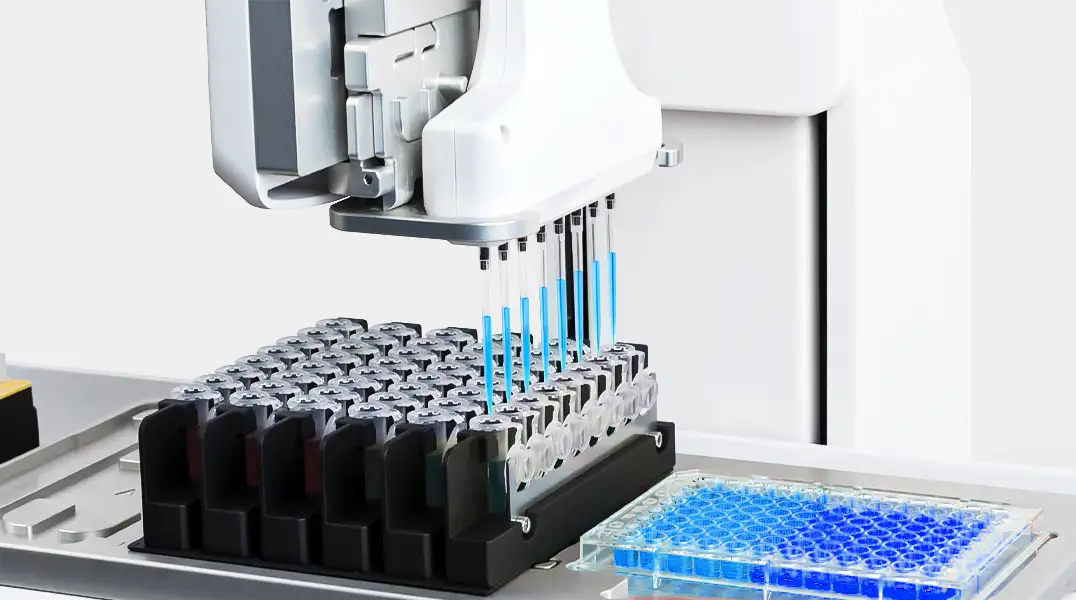
Robotic pipetting has transformed modern labs by automating repetitive liquid transfers with speed and precision, and the choice of robotic pipette tips is central to that performance.
A robotic pipette tip is far more than a disposable piece of plastic. It serves as the interface between the robotic liquid handling system and the sample itself, determining how precisely and consistently volumes are transferred. Its geometry, surface treatment, filtration, and mechanical fit with the robotic arm all influence accuracy, reproducibility, and contamination control. For bench scientists, the right tip means fewer errors and more consistent data; for laboratory managers and procurement professionals, it translates into higher throughput, lower costs, and improved compliance.
This ultimate guide explores how robotic pipetting works, what a robotic pipette tip is, the various types available, and the essential factors that define quality and performance. Whether you are a lab technician, a product engineer, or a decision-maker in automated liquid handling, this resource provides comprehensive answers and valuable insights into one of the most essential tools in modern laboratory automation.
How Does Robotic Pipetting Work?
Robotic pipetting is the liquid-handling method performed within automated liquid handling systems (ALHS)—commonly known as automated pipetting stations. These systems automate the key actions of aspiration, dispensing, mixing, and tip handling, allowing laboratories to process large numbers of samples with far greater accuracy and consistency than manual pipetting.
At the core of robotic pipetting is a programmable pipetting head equipped with single-channel or multi-channel actuators. Guided by software-controlled coordinates, the system positions the pipetting head precisely over plates, tubes, or reservoirs on the deck layout. Once the robotic pipette tips are loaded, the system uses either air-displacement or positive-displacement mechanisms to aspirate and dispense exact liquid volumes.
Most modern automated pipetting stations also integrate liquid-level detection (LLD)—either capacitive or pressure-based—to ensure correct tip immersion depth and prevent aspiration errors. Advanced models include sensors that monitor clogging, dripping, air gaps, or abnormal pressure patterns, further improving accuracy and reproducibility.
Beyond pipetting, today’s automated platforms often include functional modules such as shakers, heaters, magnetic separators, and plate movers. These components allow the workstation to perform entire workflows—from PCR setup and ELISA preparation to library construction and high-throughput screening—without manual intervention.
In essence, robotic pipetting replaces user-dependent manual operations with standardized, programmable, and highly repeatable liquid-handling processes. As laboratories scale their testing volume and adopt more complex assays, automated pipetting has become essential for achieving high throughput, contamination control, and reliable experimental results.
What is a Robotic Tip
A robotic pipette tip—often simply called a robotic tip—is a specially engineered, disposable consumable designed for use with automated liquid handling systems. Unlike traditional manual pipette tips, robotic tips are precisely manufactured to interface with liquid-handling robots, ensuring accurate, consistent, and contamination-free pipetting across thousands of samples.
At its core, a robotic tip performs the same basic function as any pipette tip: it aspirates and dispenses liquid. However, its design tolerances, material quality, and surface characteristics are significantly more demanding. These tips must align perfectly with robotic pipetting heads, forming an airtight seal that enables consistent volume transfer under programmed control. Even a minor variation in shape, fit, or wall thickness can lead to volume errors or mechanical failures — unacceptable in high-throughput and regulated environments.
Key Characteristics of Robotic Pipette Tips
-
Precision Fit and Compatibility
Robotic tips are tailored for specific liquid handling systems (e.g., Hamilton, Tecan, Beckman Coulter, Opentrons, Agilent, and others). Each manufacturer’s tip design ensures a secure fit, precise calibration, and optimal performance with the corresponding robotic arm. -
High Manufacturing Accuracy
Advanced injection molding technologies and cleanroom production environments ensure consistent tip geometry and volume accuracy, minimizing variability between tips — a crucial factor for reproducible results. -
Material and Surface Treatment
Most robotic tips are made from medical-grade polypropylene, often treated to be low-retention or hydrophobic to reduce liquid adhesion. This improves accuracy in transferring viscous or low-volume samples. -
Filter Integration (Optional)
Many robotic tips include built-in aerosol barriers or filters, preventing sample cross-contamination and protecting the robot’s pipetting channels from biohazardous or volatile materials. -
Traceability and Sterility Options
Depending on laboratory needs, robotic tips may be sterile, RNase/DNase-free, and individually certified. Some suppliers also provide lot traceability and barcode labeling for integration with laboratory information systems (LIMS).
Why They Matter
In high-throughput laboratories — such as genomics, drug discovery, or clinical diagnostics — the robotic pipette tip is the unsung hero enabling automation efficiency. It ensures that every sample is treated identically, guaranteeing data consistency and minimizing human error. Without precision-engineered tips, even the most advanced liquid handling robot would fail to deliver the reproducibility that modern science demands.
History and Evolution of Robotic Tips
The evolution of robotic pipette tips is closely tied to the rise of automated liquid handling in modern laboratories. In the early days of laboratory automation during the 1980s and 1990s, most liquid-handling systems relied on modified versions of manual pipette tips, which often lacked the precision, consistency, and durability required for automated workflows. As high-throughput screening, genomics, and clinical diagnostics expanded, laboratories demanded tools that could deliver reliable and repeatable results at scale — laying the foundation for purpose-built robotic tips.
By the early 2000s, manufacturers began engineering specialized, automation-ready pipette tips with tighter dimensional tolerances and improved material purity. These innovations ensured consistent fit with robotic pipetting heads, minimized volume variability, and reduced contamination risks. The introduction of filter-integrated robotic tips, low-retention surface technologies, and cleanroom production standards further improved accuracy and sample integrity, particularly in sensitive applications such as PCR, next-generation sequencing, and diagnostic assays.
Today’s robotic pipette tips represent decades of material science, precision molding, and automation engineering. Modern designs incorporate advanced polymer treatments, automated quality control, and compatibility with smart liquid-handling systems capable of detecting seal integrity, aspiration pressure, and tip alignment. As laboratories continue to adopt higher-throughput workflows and integrate AI-driven automation, robotic tips will remain a cornerstone of reliable liquid handling — evolving alongside the systems they support.
Types of Robotic Tips
In automated liquid-handling systems, robotic pipette tips are primarily categorized based on whether they support liquid-level sensing (LLD). This distinction is critical because it determines how the robot detects the surface of a liquid before aspiration, directly affecting accuracy, sample protection, and workflow compatibility.
Conductive Robotic Tips
Conductive tips are engineered using polymers blended with carbon or graphite particles, enabling the tip to conduct electricity. When paired with an automation system that supports capacitive or contact-based LLD, these tips allow the robot to detect the liquid surface precisely.
1. Key Features
- Supports Liquid-Level Detection (LLD) for accurate aspiration
- Reduces the risk of aspiration errors or tip submersion
- Essential for low-volume, high-precision workflows
- Commonly used in assays requiring strict control of aspiration depth
2. Typical Applications
-
Genomics and NGS sample prep
-
qPCR and PCR workflows
-
Clinical diagnostics
-
High-throughput screening
Conductive tips are widely used on platforms such as Hamilton STAR, Tecan Fluent/EVO, Beckman Biomek i-Series, and other systems that depend on LLD for pipetting reliability.
Non-Conductive Robotic Tips
Non-conductive tips are made of standard polypropylene without conductive additives. These tips cannot be used for capacitive LLD but are compatible with systems that rely on pressure-based sensing, fixed-depth aspiration, or workflows that do not require liquid-level detection.
1. Key Features
-
Cost-effective and widely used
-
Suitable for pressure-sensing robotic heads
-
Ideal for bulk liquid handling or high-volume transfers
-
Compatible with a wide range of automated platforms
2. Typical Applications
-
Reagent dispensing
-
Plate filling
-
Serial dilutions
-
Buffer preparation
-
General automation workflows with less stringent volume control needs
Additional Performance Variants
Robotic pipette tips also include variations commonly shared with conventional pipette tips, such as:
-
Filter (barrier) vs. non-filter tips
-
Low-retention surface treatments
-
Wide-bore formats
-
Sterile or cleanroom-manufactured options
Because these characteristics align with standard pipette tip classifications and are not unique to robotic systems, they are mentioned here solely for completeness and are not the focus of this section.

Performance Metrics: What Makes a Good Robotic Tip?
Selecting the right robotic pipette tip is more than just matching a volume specification—it’s about ensuring the tip consistently delivers high performance in an automated liquid-handling environment. Below are the key metrics and criteria that laboratories (both end-users and procurement teams) should evaluate to determine whether a robotic tip is up to the job.
Accuracy and Precision
Accuracy refers to the closeness of the dispensed volume to the target volume, while precision (or repeatability) reflects how consistent successive transfers are. A high-quality robotic tip enables the automated system to stay within very tight tolerances. For example, studies show that errors in liquid-handling accuracy can significantly impair assay performance. (Source: ScienceDirect – Effect of Liquid-Handling Accuracy on Assay Performance)
When evaluating tips, consider the coefficient of variation (CV) of volume transfers. Manufacturers may claim CVs under 2% for high-throughput tips.
Environment and liquid properties (viscosity, temperature) still impact performance. For instance, one study optimized aspiration and dispensing parameters for viscous liquids, highlighting that tip geometry and handling method matter. (Source: Optimization of liquid handling parameters for viscous liquid transfers with pipetting robots, a “sticky situation”)
In short, a good robotic tip should support volume accuracy and precision appropriate for your system’s throughput and application requirements.
Compatibility & Fit with the Automation Platform
A high-quality robotic pipette tip must ensure a reliable and airtight fit with the pipetting head of the automation platform. Poor dimensional accuracy in the tip’s collar, wall thickness, or taper can lead to leakage, misalignment, or aspiration errors, all of which compromise the integrity of automated workflows. Research on liquid-handling failures confirms that mechanical fit issues are one of the most common contributors to volume inaccuracy and workflow interruptions(Source: Automated Liquid Handlers as Sources of Error).
For automated systems that depend on liquid-level detection (LLD), compatibility extends beyond physical fit. Conductive tips must have consistent electrical properties to enable stable capacitive sensing, while non-conductive tips must support reliable pressure-based detection. Ensuring compatibility at both the mechanical and sensing levels is fundamental to reproducible automated performance.
Sample Retention and Liquid Recovery
Internal surface quality plays a significant role in how much liquid remains inside a tip after dispensing. Studies show that even small variations in surface smoothness or hydrophobicity can lead to measurable residual volume, especially when handling viscous reagents or low-volume transfers.
Low-retention polymer treatments, precision molding, and optimized tip geometry help reduce sample adhesion and improve liquid recovery. For workflows involving enzymes, nucleic acids, or high-value reagents, minimizing sample loss directly contributes to cost efficiency and data reliability.
Contamination Control & Integrity
In automated environments, preventing aerosol carry-over, splashback, or cross-contamination is essential for maintaining assay integrity. Research in molecular diagnostics highlights that aerosol contamination remains a key risk factor affecting the accuracy of PCR and NGS workflows.
Additionally, the manufacturing process of robotic tips—such as cleanroom molding, absence of additives that may leach, and strict QC inspection—has been identified as a major determinant of tip purity and batch-to-batch consistency. These factors collectively ensure that each tip supports contamination-free, high-reliability automated operation.
Workflow Efficiency and Throughput Performance
Automation efficiency depends not only on the robot’s software or hardware, but also on how reliably tips can be picked up, sealed, used, and ejected. Studies evaluating high-throughput liquid handling systems report that tip-related issues—such as inconsistent mounting force, poor rack tolerances, or ejection resistance—can significantly slow down total cycle time and increase machine pauses.
A well-designed robotic pipette tip supports smooth engagement and ejection, stable sealing during aspiration, and consistent performance across thousands of cycles. These characteristics help laboratories maintain uninterrupted workflows and predictable throughput, which is especially critical for large-scale screening, diagnostics, or clinical operations.
When purchasing or evaluating robotic pipette tips, look for accuracy/precision, platform compatibility, low sample loss, contamination control, and workflow throughput. Combining these performance metrics gives you a robust basis for choosing tips that genuinely improve automation reliability.
Explore GenFollower’s robotic pipette tips
At GenFollower, we aim to provide innovative and reliable research support, enhancing the efficiency of life sciences in a sustainable way. Our robotic pipette tips are engineered with precise molding, consistent dimensions, and carefully selected materials to ensure secure system fit, stable liquid-level detection, low sample retention, and contamination-free performance. Manufactured under strict quality standards, they deliver the accuracy and repeatability required for high-throughput and automated workflows.
Beyond robotic pipette tips, GenFollower offers a broad range of laboratory consumables designed to support modern research. We welcome you to explore our full product portfolio .
Recent Posts
The Ultimate Guide to Agarose Gel Electrophoresis
Agarose gel electrophoresis is a standard technique used in molecular biology for the separation, identification, and purification of nucleic acids. Its operational simplicity and broad applicability make proficiency in this method a fundamental prerequisite for [...]

Weighing It Right: A Comprehensive Guide to Accurate Laboratory Weighing
Sample weighing is a critical component of analytical experiments, as inaccuracies can lead to the failure of the entire process. When weighing results are consistently inaccurate, it is essential to perform a thorough analysis [...]

Knowledge Sharing: 9 new technologies for sample preparation
Fast, automated sample preparation improves laboratory efficiency while ensuring data reproducibility by reducing human error and sample loss during transfer. These technologies also support green chemistry initiatives by minimizing solvent waste. While modern analytical [...]