
Table of Content
What is Earth Day?
Earth Day began in the United States in the early 1970s, when a burgeoning environmental movement on college campuses sought to awaken public consciousness towards the fragility of our planet. The first event, held on 22 April 1970, became the first large-scale campaign for environmental protection, inspiring together millions of people to call for cleaner air, safer water, and a healthier environment.
By the 1990s, this once-national event had spread around the world, becoming an annual day of action and awareness for environmentalists everywhere. Today, 22 April serves as a strong reminder of our shared responsibility to protect the Earth for future generations.
As scientists work to solve big problems, Earth Day is a good reminder: progress and protecting the planet should go hand in hand — especially in the lab.
Earth Day and the Laboratory Industry
Even though Earth Day encourages us to care for the planet, labs are still a major source of plastic waste. Every year, labs throw away huge amounts of single-use items like pipette tips, tubes, and containers — most of which don’t get recycled or reused.
In 2014 alone, laboratories worldwide generated an estimated 5.5 million tonnes of plastic waste—equivalent in weight to some 67 ocean‑going cruise ships (a figure reported in Nature, 2015). As awareness grows, it becomes ever more imperative for research facilities to embrace more sustainable practices, ensuring that the pursuit of knowledge no longer comes at the planet’s expense.
GenFollower’s Commitment to Sustainability
At GenFollower, we’re aware of our duty to the planet. This sense of responsibility guides us as we develop new lab products. We believe it’s possible to innovate while cutting carbon and cutting plastic. Our goal is to offer lab tools that work brilliantly and are kinder to the Earth.
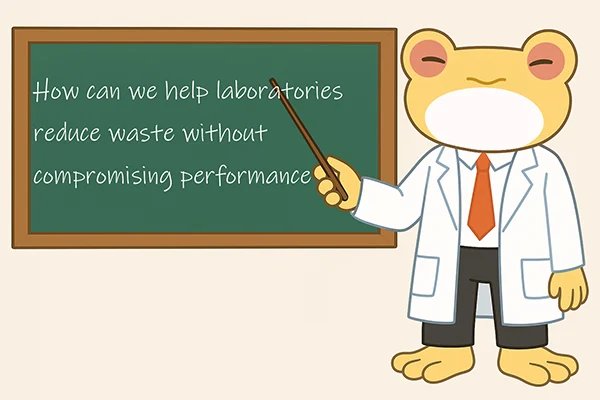
Our commitment is grounded in a practical question: how can we help laboratories reduce waste without compromising performance?
Our Three Pillars: Reduce & Reuse
We follow a simple rule: use less, and use again.
- Reduce – Packaging: Refill system packs help reduce single‑use plastic wrap and outer boxes.
- Reduce – Products: Our consumables, like universal pipette tips, are made with about 20% less plastic than other brands, lightening waste and transport.
- Reuse: Some of the tools, like tip racks and freezer boxes, can be cleaned, sterilized and used again, saving plastic from the bin.
When used widely, these small product changes can really help reduce its environmental impact.
Let’s Make Earth Day Every Day
Earth Day is more than a date on the calendar — it’s a call to action. We’re inviting researchers, lab managers and partners to take this chance to look at everyday lab work through a more sustainable lens.
Simple steps — like picking greener products or reusing what you can — really do add up. When teams do these things every day, being sustainable just becomes a normal part of the job.
At GenFollower, we continue to push for progress — through better design, smarter packaging, and responsible innovation. We invite you to follow our journey and take part in it.
Want to see what that looks like? Take a look at our sustainable lab tools or directly get in touch with us.
Let’s take care of the Earth, together — not just on Earth Day, but every day.
Recent Posts
Cell Cryopreservation: Common Protocols, Thawing Tips, and FAQs
Imagine this scenario: You’ve spent months carefully cultivating a unique cell line or editing a specific gene. The data looks promising, and it’s time to bank these precious samples for future verification. You freeze [...]

Comprehensive Analysis of Lab Automation Workstations: Mainstream Brand Selection Guide
Let’s face it: nobody becomes a scientist because they love pipetting 384-well plates by hand. It is tedious, physically draining, and—worst of all—prone to human error that can quietly ruin weeks of hard work. [...]

Fast Guide to Robotic Pipetting and Robotic Pipette Tips
Robotic pipetting has transformed modern labs by automating repetitive liquid transfers with speed and precision, and the choice of robotic pipette tips is central to that performance. A robotic pipette tip is far more [...]